GETTING IT RIGHT IN CAMERA
16th March 2026
Richard Houghton came from Leicester to give us a different sort of night. He exuded confidence as he explained his addiction to photography and accompanying aversion to sitting at a computer trying to rectify or improve on what he had achieved with his camera. His theme was to give advice on ‘How to Get it Right in Camera’ followed by a practical evening to try out his suggestions.
Richard showed various generations of his cameras, starting, aged 8, with a Kodak box Brownie. This offered no adjustments at all and the photographer had to make sure they were in the right place to get their shot in focus. Successive improvements to cameras allowed more control on behalf of the photographer to get the shot they wanted.
Richard engaged his audience in a discussion on the things photographers can control these days and the effect of doing so – or not. Composition is surely the easiest parameter to manage. It requires little more than that the photographer looks carefully through the viewfinder and makes sure the important items are included and positioned to best effect within the shot. The rule of thirds offers four points of particular strength.
The choice between portrait and landscape orientation may be determined by the shape of the required view, but it can also be used to exclude unwanted aspects of the surrounding area. In the case of the horizon, most landscape images are in landscape orientation, but where the horizon falls can make or break the composition. A great sky deserves plenty of space, so the horizon should be positioned approximately 2/3 of the way down the shot. Conversely a mediocre sky needs to be minimised, if it cannot be eliminated entirely, so a horizon in the top third of the shot is preferred.
The photographer needs to decide which parts of the shot they want sharply in focus. In a traditional landscape shot where most things need to be sharp, focussing approximately 1/3 of the way into the view will achieve the desired result. Modern DSLR cameras have multiple focal points contrasting with the single point in older cameras. This means that the photographer needs to think about what they are doing.
The camera cannot read the mind and if you point it at a scene, it will focus on the nearest things if a wide range of focal points is selected. Richard quoted the example of a shot he judged which was reduced to a sharp hedge with the attractive view disappearing increasingly blurred into the background. The photographer was new to her camera and did not know how to adjust her settings nor why it mattered. A second’s thought can avoid disappointment.
We saw two shots Richard had taken of the same scene. There was a church tower in the background and some dark purple thistles in the front. When the thistles were sharp, the church tower was a pleasant background element. When the church was sharp, the thistles were a dark and distracting foreground feature. We keep hearing from judges about eliminating distractions and this was a telling example.
We considered the effect of the time of day when outdoor shots are taken. There are the obvious key times of dawn, sunset and the blue hour afterwards. There was also a discussion about mid-day sun. This is not helpful for portraits etc, and wedding hats can cast huge shadows over faces. The wedding photographer may have a different opinion about a bright, sunny day from the happy couple, while an infra-red photographer would agree wholeheartedly with them as a bright sunny day is best for their art.
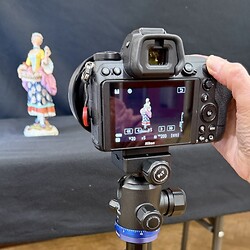
Having given so much advice about what to do to achieve a good photo, Richard set up some still life subjects and lights for everyone to have
a go at putting his advice into practice. It was an excellent evening and Richard was warmly thanked at the end.
The previous week, Lee Dalgleish had given a tutorial on how he uses Lightroom to process his competition winning images. This shows that there is room in our working practices to use all the tools at our disposal and members had enjoyed the opportunity.
Next week we will be holding the print and digital memorial trophy competitions which bring to an end the competitive element of our season.
Club nights continue until the end of April. We hope to see everyone then and maybe a few new faces as well. Full details of the club and programme are on the club web site: http://www.retford-photographic.co.uk/
Meetings are weekly on Mondays at 7.30pm in St Joseph’s Hall, Babworth Road.
Richard showed various generations of his cameras, starting, aged 8, with a Kodak box Brownie. This offered no adjustments at all and the photographer had to make sure they were in the right place to get their shot in focus. Successive improvements to cameras allowed more control on behalf of the photographer to get the shot they wanted.
Richard engaged his audience in a discussion on the things photographers can control these days and the effect of doing so – or not. Composition is surely the easiest parameter to manage. It requires little more than that the photographer looks carefully through the viewfinder and makes sure the important items are included and positioned to best effect within the shot. The rule of thirds offers four points of particular strength.
The choice between portrait and landscape orientation may be determined by the shape of the required view, but it can also be used to exclude unwanted aspects of the surrounding area. In the case of the horizon, most landscape images are in landscape orientation, but where the horizon falls can make or break the composition. A great sky deserves plenty of space, so the horizon should be positioned approximately 2/3 of the way down the shot. Conversely a mediocre sky needs to be minimised, if it cannot be eliminated entirely, so a horizon in the top third of the shot is preferred.
The photographer needs to decide which parts of the shot they want sharply in focus. In a traditional landscape shot where most things need to be sharp, focussing approximately 1/3 of the way into the view will achieve the desired result. Modern DSLR cameras have multiple focal points contrasting with the single point in older cameras. This means that the photographer needs to think about what they are doing.
The camera cannot read the mind and if you point it at a scene, it will focus on the nearest things if a wide range of focal points is selected. Richard quoted the example of a shot he judged which was reduced to a sharp hedge with the attractive view disappearing increasingly blurred into the background. The photographer was new to her camera and did not know how to adjust her settings nor why it mattered. A second’s thought can avoid disappointment.
We saw two shots Richard had taken of the same scene. There was a church tower in the background and some dark purple thistles in the front. When the thistles were sharp, the church tower was a pleasant background element. When the church was sharp, the thistles were a dark and distracting foreground feature. We keep hearing from judges about eliminating distractions and this was a telling example.
We considered the effect of the time of day when outdoor shots are taken. There are the obvious key times of dawn, sunset and the blue hour afterwards. There was also a discussion about mid-day sun. This is not helpful for portraits etc, and wedding hats can cast huge shadows over faces. The wedding photographer may have a different opinion about a bright, sunny day from the happy couple, while an infra-red photographer would agree wholeheartedly with them as a bright sunny day is best for their art.
Having given so much advice about what to do to achieve a good photo, Richard set up some still life subjects and lights for everyone to have
a go at putting his advice into practice. It was an excellent evening and Richard was warmly thanked at the end.
The previous week, Lee Dalgleish had given a tutorial on how he uses Lightroom to process his competition winning images. This shows that there is room in our working practices to use all the tools at our disposal and members had enjoyed the opportunity.
Next week we will be holding the print and digital memorial trophy competitions which bring to an end the competitive element of our season.
Club nights continue until the end of April. We hope to see everyone then and maybe a few new faces as well. Full details of the club and programme are on the club web site: http://www.retford-photographic.co.uk/
Meetings are weekly on Mondays at 7.30pm in St Joseph’s Hall, Babworth Road.