PANEL OF THREE COMPETITION
27th January 2026
Our annual trophies are decided by the combined scores accrued in the qualifying competitions and this was the final one for 2026. Each member can submit one set of three prints and three sets of digital images for judging. The criteria are that the images should tell a story or have a theme. Over the years we have had various tips and hints from our judges, which were mostly followed this year. Tonight, Steve Myall summed up his approach to judging before he began his critique and added some more food for thought for future occasions.
Most members had adhered to earlier advice to have a central image flanked by images either side which draw the eye to the central one, creating a harmonious feel overall. Steve added that he looks for balance. By this he meant the layout, the colour temperature, the size of the subject in the frame and with no one photo standing out for better or worse. He commented that no manner how many images you are asked to provide for a panel, you always struggle for the last one. It seemed a few members would have known what he meant.
Our competition rules say that the images are judged, but not the mounts. Steve pointed out that under the lights of a print stand light will reflect strongly off a near white mount and make it harder for the judge to see beyond the mount to the image. He commented that he usually offers a near white, a mid-grey and a black mount to his competition images and decides which works best. In this competition members had all used the same mount board for each of their three images and most were near white.
The colour print class had seven entries making a total of 21 images to view. Competitors enter their sets anonymously, indicating the order and orientation in which they are to be displayed for the judge. For each set, Steve looked at the individual images, commenting on their qualities. He then looked at the three together and judged them according to his previously expressed criteria for a panel. The first two sets were held back for further consideration.
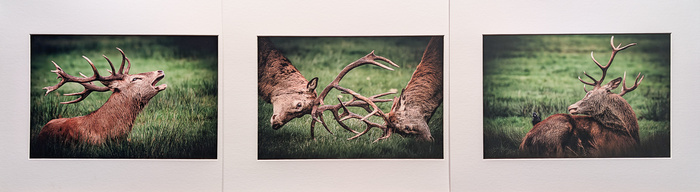
Steve commented on the relative sharpness of the three images and the background in each. The first had one image of a lion with a much brighter light than the other two. By contrast the second image had all three images in very much the same colour tone against a similar background and with a dark vignette to draw the eye to the action of the featured stags, all of which appeared as a similar size in all images.
Steve also very much liked a panel showing an Iberian Green Woodpecker in black mount board. He commented on the strength of the nature photography in the club, which has been remarked on before. His final selection to review were these three, all nature panels, which were viewed together. The winner after due deliberation was the stags, by Lee Dalgleish.
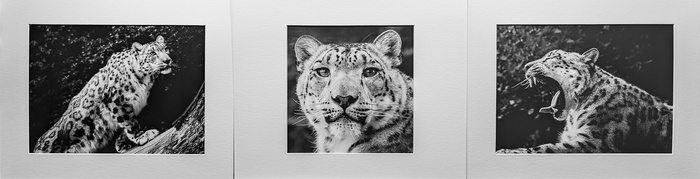
There were only five entries in the monochrome class. The first three to be shown were held back. The first showed shots of a, kestrel, which caused Steve to remark on how unusual it is to have monochrome nature images. The third panel showed a snow leopard, which particularly suited the monochrome format. These two, with a panel featuring ladies at a period costume event, were the three reviewed for the higher scores. The winner was chosen as Tom Coulson, author of the snow leopard panel.
After a pleasant social break, we came to the digital images class. We have a system which handles the upload of the images via the internet. It resizes each to best fit the space available for projection and fills any blank space with black. It is up to the author to specify the order in which their images appear.
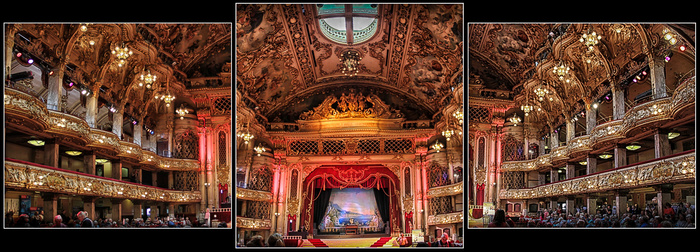
As always, we were shown a run through of all the seventeen entries. This time Steve scored more at his first viewing. He ended up with five panels to review, which he was able to do quite quickly. Another set of kestrels, this time from Lee Dalgleish, received 18 points for third place and then it was obviously a very close call between the submissions of Joyce Bell, showing the Tower Ballroom and Rob Neal’s cleverly posed wooden mannequins as a band. After some thought the prize went to Joyce Bell with her ballroom shots while Rob Neal took second.
It was a good, informative and interesting night with some excellent images, which was made better by the helpful comments from Steve, who was a model of clarity and consistency.
Next week we welcome Peter and Susie Jones with ‘Wildlife in Cold Places’, and the following week we will view the night time shots prepared by our members which had to be postponed when we could not access the hall earlier in the year. We hope to see everyone there. Club nights continue until 20th April, and guests or new members are always welcome.
Full details of the club and programme are on the: http://www.retford-photographic.co.uk/
Meetings are weekly on Mondays at 7.30pm in St Joseph’s Hall, Babworth Road.
Most members had adhered to earlier advice to have a central image flanked by images either side which draw the eye to the central one, creating a harmonious feel overall. Steve added that he looks for balance. By this he meant the layout, the colour temperature, the size of the subject in the frame and with no one photo standing out for better or worse. He commented that no manner how many images you are asked to provide for a panel, you always struggle for the last one. It seemed a few members would have known what he meant.
Our competition rules say that the images are judged, but not the mounts. Steve pointed out that under the lights of a print stand light will reflect strongly off a near white mount and make it harder for the judge to see beyond the mount to the image. He commented that he usually offers a near white, a mid-grey and a black mount to his competition images and decides which works best. In this competition members had all used the same mount board for each of their three images and most were near white.
The colour print class had seven entries making a total of 21 images to view. Competitors enter their sets anonymously, indicating the order and orientation in which they are to be displayed for the judge. For each set, Steve looked at the individual images, commenting on their qualities. He then looked at the three together and judged them according to his previously expressed criteria for a panel. The first two sets were held back for further consideration.
Steve commented on the relative sharpness of the three images and the background in each. The first had one image of a lion with a much brighter light than the other two. By contrast the second image had all three images in very much the same colour tone against a similar background and with a dark vignette to draw the eye to the action of the featured stags, all of which appeared as a similar size in all images.
Steve also very much liked a panel showing an Iberian Green Woodpecker in black mount board. He commented on the strength of the nature photography in the club, which has been remarked on before. His final selection to review were these three, all nature panels, which were viewed together. The winner after due deliberation was the stags, by Lee Dalgleish.
There were only five entries in the monochrome class. The first three to be shown were held back. The first showed shots of a, kestrel, which caused Steve to remark on how unusual it is to have monochrome nature images. The third panel showed a snow leopard, which particularly suited the monochrome format. These two, with a panel featuring ladies at a period costume event, were the three reviewed for the higher scores. The winner was chosen as Tom Coulson, author of the snow leopard panel.
After a pleasant social break, we came to the digital images class. We have a system which handles the upload of the images via the internet. It resizes each to best fit the space available for projection and fills any blank space with black. It is up to the author to specify the order in which their images appear.
As always, we were shown a run through of all the seventeen entries. This time Steve scored more at his first viewing. He ended up with five panels to review, which he was able to do quite quickly. Another set of kestrels, this time from Lee Dalgleish, received 18 points for third place and then it was obviously a very close call between the submissions of Joyce Bell, showing the Tower Ballroom and Rob Neal’s cleverly posed wooden mannequins as a band. After some thought the prize went to Joyce Bell with her ballroom shots while Rob Neal took second.
It was a good, informative and interesting night with some excellent images, which was made better by the helpful comments from Steve, who was a model of clarity and consistency.
Next week we welcome Peter and Susie Jones with ‘Wildlife in Cold Places’, and the following week we will view the night time shots prepared by our members which had to be postponed when we could not access the hall earlier in the year. We hope to see everyone there. Club nights continue until 20th April, and guests or new members are always welcome.
Full details of the club and programme are on the: http://www.retford-photographic.co.uk/
Meetings are weekly on Mondays at 7.30pm in St Joseph’s Hall, Babworth Road.